Edited by Paola Nola and Tatiana Storchi
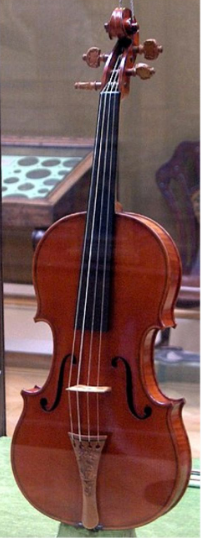
Built by the master violin maker Antonio Stradivari in 1716, the instrument now known as the ‘Messiah’ has given rise to legends and mysteries, some of which remain unsolved.
It seems that, unusually, the violin remained in the master’s workshop, never having been played, until the date of his death in 1737. Thanks to a series of fortunate circumstances, the violin has come down to us, 300 years later, in perfect condition, as if it had just left the master’s workshop. During these three centuries, it has been played on only very rare occasions.
Since Stradivari’s death, the violin has been sold several times. In 1827, it was purchased by the collector and dealer Luigi Tarisio, who was constantly on the lookout for instruments to sell in Paris and London. During his travels, Tarisio would always speak of an extraordinary Stradivari, “which can only be admired on one’s knees. It has never been played and is so new that it is as if it had come from the Master’s hands today”. One day, a great French violinist, Jean Delphin Alard, impatiently said to him: “But come on, your violin is like the Messiah of the Jews; we are always waiting for it but it never appears”. From that moment on, the violin was called the “Messie”. After Tarisio’s death, the violin was purchased by the luthier Jean-Baptiste Vuillaume, who was so captivated by it that he made several copies.
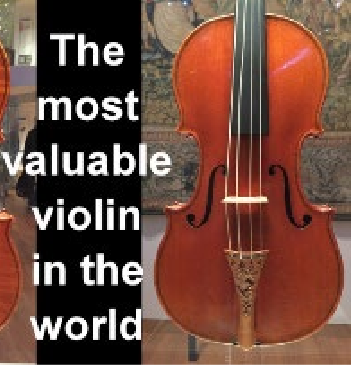
Finally, after changing owners several times, the violin was purchased by the Hills in 1904 and donated by Hill & Sons in 1939 to the Ashmolean Museum in Oxford (UK), so that it might be preserved as “a model from which future violin makers might learn”. The deed of donation included a clause stipulating that the instrument should never be played and should never leave the Museum. The violin is currently insured for $20 million. Throughout its long history, however, its authenticity has been called into question, leading to uncertainty about its enormous value. The numerous copies made by Jean-Baptiste Vuillaume have led some to doubt that it was actually made by the French luthier and that its attribution to Stradivari is nothing more than a legend.
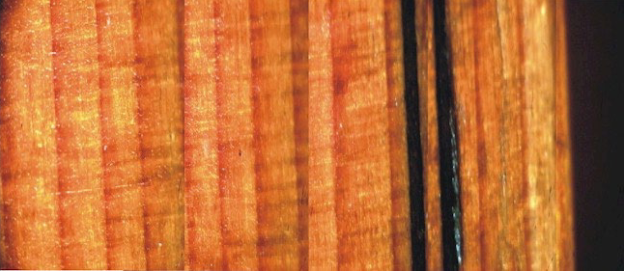
The debate was resolved when a number of dendrochronology experts were able to examine the instrument and, in particular, measure the annual growth rings of the soundboard. By comparing the variations in the rings of the Messiah with those of two other instruments made by the Master (the two violas Archinto and Kux-Castelbarco), a correspondence was found that allowed the most recent ring on the soundboard to be dated to 1687. The wood used, therefore, turned out to be significantly older than the period during which Vuillaume was active, dating back to a time contemporary with other instruments made by Stradivari.
Naturally, the dating of the wood only allows us to establish the so-called ‘terminus post quem’, that is, it indicates that the violin was built after 1687, since in that year the tree was still alive and growing, but it cannot provide information on the date of the instrument’s construction.
In fact, many other characteristics are used to determine the authenticity of a work, such as style, dimensions, decorative techniques, varnishes and more.
Dendrochronological dating, however, makes it possible to identify fakes, copies or misattributions when the ‘terminus post quem’ falls after the death of a particular maker.
Although studies have shed light on the authorship of the Messiah, certain aspects of the violins made by Stradivari remain shrouded in mystery to this day. In particular, research is still ongoing into what makes the sound of these instruments so unique and inimitable, seeking to reconstruct the characteristics of the wood used, the treatments it underwent prior to crafting, as well as the composition of the varnishes that completed the instrument.
Perhaps their appeal also lies in the fact that not everything has been explained!